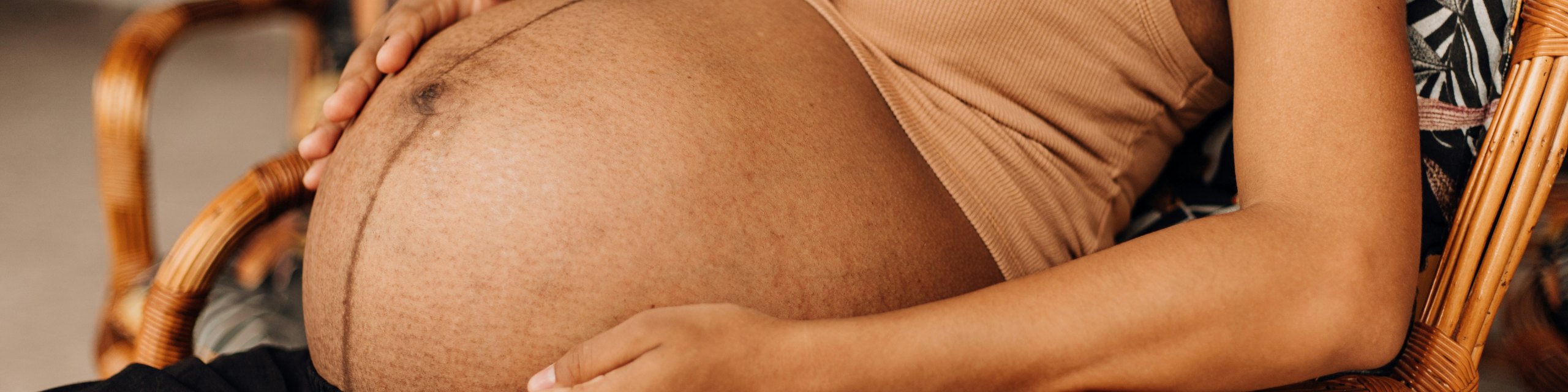
How inequality reaches the pregnant body
Pregnancy doesn’t happen separately from the rest of someone’s life. It happens inside neighborhoods, schools, workplaces, relationships, healthcare systems, and communities that have often been shaping a person’s health for years before they ever become pregnant.
Consider two families preparing to welcome a baby. One lives close to a grocery store, a park, and a hospital with obstetric services. The other lives in a neighborhood where the nearest birth unit has closed, reliable transportation is difficult, and getting to prenatal care means taking multiple buses or missing hours of work. One family has paid leave and savings. Another loses income every time an appointment runs long or a child gets sick. None of those circumstances guarantee exactly what will happen during pregnancy or birth. But they absolutely do shape what each family has to work with before labor ever begins.
If you’ve ever watched a relay race, you know the final runner isn’t responsible for every second on the clock. They’re carrying whatever position the team handed them. Pregnancy works a little like that. By the time someone becomes pregnant, their body has already been carrying years — sometimes decades — of experiences that influence health.
Pregnancy does not place someone outside the life they were already living. In many ways, it brings that life into sharper view.
By the time someone has their first prenatal appointment, they may have spent years living with air pollution, long work hours, poor access to care, housing problems, financial pressure, or the stress of being watched and doubted in ways other people are not. A chart may list high blood pressure as a risk. It cannot always show everything that helped bring that blood pressure to where it is.
The framework in this chapter shows several parts of life that can affect health: money, housing, education, work, transportation, the environment, political power, the criminal legal system, and healthcare itself. It’s easy to think of these as separate problems. Housing belongs to one department. Transportation belongs to another. Healthcare belongs somewhere else. But our bodies don’t experience life one agency at a time. They experience all of it at once.
Exhibit · Interactive
Nine disparities, one system
Switch between the isolated view and the compounding view, then select any node.
Source · The nine domains are the exhibition’s own grouping. Underlying evidence from Arline T. Geronimus, Weathering (Little, Brown Spark, 2023), and the CDC National Center for Health Statistics.
A housing problem can affect sleep, stress, transportation, and exposure to mold or heat. A job with no paid leave can lead to missed appointments or less time to recover after birth. A closed hospital unit can turn a short trip into a long drive. A school system can affect future work and income. Political decisions sit behind many of these conditions because people decide which roads are repaired, which hospitals receive support, which workers receive protection, and which neighborhoods receive investment.
This is where the idea of weathering becomes helpful. Dr. Arline Geronimus developed the term to describe what can happen to the body after years of adapting to ongoing stress and unequal conditions. Weathering is not the same as having one difficult week or one stressful pregnancy. It describes the wear that can build when the body has to stay ready for challenge again and again.
Think about a favorite pair of shoes. Wearing them once doesn’t change much. Wearing them every day for years eventually does. Our bodies also respond to repeated experiences. It’s rarely one difficult day that changes them. It’s what happens over time.
We often talk about pregnancy as though it’s where the story begins. In many cases, it’s where a much longer story becomes visible.
This does not mean a diagnosis was destined to happen or that every person living with stress will have the same outcome. It means we should be careful about describing a complication as if it appeared from nowhere. When someone develops preeclampsia, diabetes, or another serious concern, the pregnancy may be the time when the condition is identified, not the first time the body was affected by the circumstances around it.
A doula turned journalist on the relationship between race, class and illness, and on a prenatal care program built to buffer the stress this chapter maps. TED Conferences, LLC. Loaded only when you press play.
Healthcare sits in a difficult position here. Clinicians often meet the effects of problems they did not create: Imagine seeing six patients before lunch. One missed two earlier appointments because she couldn’t get time off work. Another drove ninety minutes because her local birth unit closed. Another stopped taking medication because she couldn’t afford to refill it. Another is sleeping on a relative’s couch after losing her housing. None of those circumstances happened inside the exam room. But every one of them walks through the door with the patient.
Medicine can’t solve every one of those problems during a prenatal visit. But it can recognize that they are part of a patient’s health — not background information.
That understanding should not lower expectations for clinical care. It should make care more responsive. A missed visit can be recorded as noncompliance, or it can lead someone to ask what made the visit hard to attend. A treatment plan can be medically sound and still impossible for a patient to follow without transportation, childcare, money, or time away from work.
There is also another form of stress Black families may carry into pregnancy: the knowledge that Black women are more likely to die or experience severe harm during childbirth. Today, maternal mortality statistics appear in newspaper headlines, documentaries, podcasts, social media posts, and conversations between friends. Many Black women enter pregnancy already knowing those numbers. That knowledge becomes part of the pregnancy too.
Exhibit · Record
The headlines, year by year
Coverage of Black maternal mortality, from 2017 forward.
2017NPR
U.S. Black Mothers Die In Childbirth At Three Times The Rate Of White Mothers
2017NPR · Lost Mothers
Black Mothers Keep Dying After Giving Birth
2018The New York Times Magazine
Why America’s Black Mothers and Babies Are in a Life-or-Death Crisis
2018National Partnership for Women & Families
Black women are three to four times more likely to experience a pregnancy-related death
2019American Heart Association
Why are black women at such high risk of dying from pregnancy complications?
2019Harvard Public Health
America is Failing its Black Mothers
2019Centers for Disease Control
Racial and Ethnic Disparities Continue in Pregnancy-Related Deaths
2019NPR · Health Shots
Black Mothers Get Less Treatment For Postpartum Pain
2020NBC News
The U.S. finally has better maternal mortality data. Black mothers still fare the worst.
2020Forbes
Why Are Black Mothers At More Risk Of Dying?
2020Good Morning America
Black mothers are twice as likely to die in childbirth
2021Avalere Health
Over the past 60 years the risk has remained about 3–4 times higher
2023PBS NewsHour
CDC reports rise in maternal mortality, Black infant deaths
2025Associated Press · PBS NewsHour
Racial gap widens in maternal mortality around the time of childbirth
2025The Century Foundation
Black Maternal Mortality Is Still Rising. What Can Be Done?
2025Penn State Office of Rural Health
Maternal Mortality Rates Fall, Except for Black Mothers
2025KFF
Black people are more than three times as likely as White people to experience a pregnancy-related death
2026Axios
Black maternal mortality rate still much higher than in other women
2017 → 202618 of many
Headlines as published, reproduced for commentary. Rates from the CDC National Center for Health Statistics, February 2025.
Exhibit · Figure
Eighty years, one ratio
How many times more likely a Black woman was to die of pregnancy than a white woman, at ten-year intervals and then across the modern surveillance record.
The underlying rates collapsed. Maternal deaths fell 98% between 1940 and 1990 — from 781.7 per 100,000 births for Black women to 18.6, and from 319.8 to 5.7 for white women. Antibiotics, transfusion, surgical technique, hospital birth. Every one of those advances arrived. The ratio between the two lines never moved. It was 4.1 in 1960, under segregation. It was 3.3 in 2023.
1940–1990: CDC, “Differences in Maternal Mortality Among Black and White Women — United States, 1990,” MMWR 1995;44(1):6–7 (maternal mortality, death-certificate basis). 2007–2016: Petersen EE et al., MMWR 2019;68:762–765 (pregnancy-related mortality, CDC Pregnancy Mortality Surveillance System). 2023: CDC PMSS, 49.4 against 14.9 per 100,000 live births. The dashed line marks the change of definition — the two stretches are not one continuous series, which is why they are drawn apart.
Get new chapters and updates →
Sources 7 entries
- Geronimus, Arline T. “The weathering hypothesis and the health of African-American women and infants: evidence and speculations.” Ethnicity & Disease 2, no. 3 (Summer 1992): 207–221.
- Geronimus, Arline T. Weathering: The Extraordinary Stress of Ordinary Life in an Unjust Society. Little, Brown Spark, 2023.
- Pérez, Miriam Zoila. “How racism harms pregnant women — and what can help.” TEDWomen 2016, October 2016.
- Headline sources as listed in the exhibit, 2017–2026. Maternal mortality rates from the CDC National Center for Health Statistics.
- PENDING — the nine domains are the exhibition’s own grouping. Per-domain citations are being compiled and are not yet on the page.
- Centers for Disease Control and Prevention. “Differences in Maternal Mortality Among Black and White Women — United States, 1990.” MMWR 44, no. 1 (January 13, 1995): 6–7.
- Petersen, Emily E., Nicole L. Davis, David Goodman, et al. “Racial/Ethnic Disparities in Pregnancy-Related Deaths — United States, 2007–2016.” MMWR 68, no. 35 (September 6, 2019): 762–765.